Introduction: The Global Impact of an Unlikely Fashion Rebel
Comme des Garçons (“Like Boys”) is one of the most influential and mysterious brands in modern fashion history. Founded in Tokyo in 1969 by Rei Kawakubo, the label traveled from the streets of Japan to the runways of Paris, forever changing the language of style. Its journey from Japan to France tells the story of how a self-taught designer disrupted the Western fashion hierarchy, built a worldwide empire, and defined the meaning of avant-garde.
Rei Kawakubo has been called a philosopher, an artist, and the mother of anti-fashion. Her belief that clothing should express emotion rather than beauty transformed what the world considers fashionable. As she once said:
“I didn’t set out to be a rebel. I just wanted to make something that didn’t exist.”
Today, Comme des Garçons stands as a bridge between East and West, intellect and instinct, art and commerce.
Origins in Japan: Rei Kawakubo Before Comme des Garçons
Born in Tokyo in 1942, Kawakubo studied fine arts and literature at Keio University before entering the design world. With no formal fashion training, she began working as a stylist for a textile company, where she quickly realized she wanted total creative control.
In 1969, she founded her own company and gave it a French name—Comme des Garçons, meaning “like boys.” The name reflected her early fascination with androgyny and gender neutrality, themes that would later define her work.
By the mid-1970s, Comme des Garçons had gained a cult following among Japanese youth who rejected traditional femininity. Kawakubo’s early collections favored black, grey, and raw edges over the bright, polished looks popular at the time.
Rei Kawakubo once said:
“My strength is finding something new, something that people have not seen before.”
The 1970s: Building a Movement in Japan
1973 — Official Launch of Comme des Garçons
Kawakubo officially registered the company and began showing her designs under the label name. Her first collections blurred the line between men’s and women’s clothing, introducing oversized silhouettes, uneven hems, and asymmetrical tailoring.
1975 — Comme des Garçons Homme
The menswear line launched in 1975, led initially by Kawakubo herself. It carried her avant-garde codes into men’s fashion—loose forms, deconstructed blazers, and muted tones. This was decades before gender-fluid fashion became mainstream.
Late 1970s — “Anti-Fashion” and the Rise of the Color Black
In the late ’70s, Comme des Garçons gained national fame with monochrome looks that emphasized shape and texture instead of decoration. Japanese critics called her aesthetic “the aesthetics of poverty,” but young consumers found it liberating. Kawakubo’s vision symbolized freedom from conformity in a rapidly modernizing Japan.
1981: The Paris Debut That Changed Everything
The world truly met Comme des Garçons in 1981, when Rei Kawakubo presented her first collection at Paris Fashion Week. The show shocked audiences accustomed to glamour and refinement.
Models walked slowly in dim light, wearing black, shredded, and asymmetrical garments. Many French critics dismissed it as ugly or nihilistic; others saw pure genius. Western media dubbed it “Hiroshima Chic,” but historians later recognized it as the start of the Japanese Avant-Garde movement.
Rei Kawakubo reflected:
“The only way of doing something new is not caring if people like it or not.”
From that moment, fashion was no longer about pleasing the eye—it became a medium for questioning culture itself.
1982–1985: The Era of Deconstruction
Following her Paris debut, Kawakubo cemented her reputation as a provocateur.
Her early-’80s collections redefined fashion through deconstruction—the exposure of seams, visible stitching, and irregular patterns.
1982 — “Destroy” Collection
Kawakubo ripped and slashed fabrics, letting threads hang loose. It symbolized destruction as creation, turning imperfection into art.
1983 — “Body Meets Dress, Dress Meets Body” (a.k.a. Lumps and Bumps)
This groundbreaking collection used padded dresses that distorted the body’s natural form. Critics were confused, but Kawakubo’s goal was philosophical—questioning why clothing must enhance a conventional body shape.
“For something to be beautiful, it doesn’t have to be pretty.” — Rei Kawakubo
1985 — Men’s Deconstruction
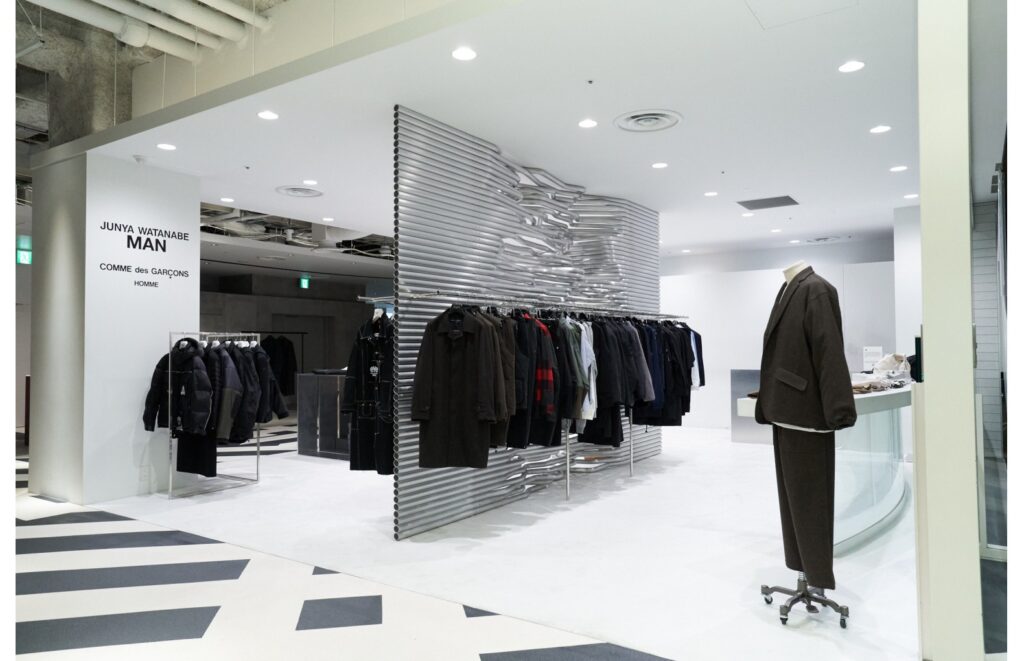
Through Comme des Garçons Homme Plus, Kawakubo applied the same philosophy to menswear, introducing deconstructed suits, inside-out linings, and playful asymmetry. This line became a recurring centerpiece of Paris Men’s Fashion Week for decades.
The Late 1980s: Expansion and Artistic Expression
By the late 1980s, CDG had become a symbol of intellectual fashion.
Boutiques opened in Tokyo, Paris, New York, and London. Kawakubo began hiring and mentoring designers who shared her spirit, including Junya Watanabe, who joined in 1987.
During this period, the collections explored contrasting themes:
- 1987 — “Blue Witch” introduced bursts of color while maintaining a dark edge.
- 1988 — Launch of Comme des Garçons Shirt, a line blending classic menswear elements with playful distortions.
- 1989 — “Dress Becomes Body” explored movement and emotion through layered knits and twisted silhouettes.
Kawakubo also started to incorporate music, installation art, and unconventional presentation spaces, turning each runway into a philosophical performance.
The 1990s: Global Recognition and the Rise of Sub-Labels
The 1990s marked both consolidation and experimentation for Comme des Garçons. Kawakubo’s name now carried international prestige, yet she resisted commercialization. Still, the decade produced some of her most influential collections and brand expansions.
1992 — Comme des Garçons Parfum
Kawakubo launched her first fragrance line with the now-iconic “Comme des Garçons Eau de Parfum.” The scent was intentionally unisex, featuring notes of incense, cedarwood, and industrial spice—mirroring her visual aesthetic of ambiguity and rebellion.
1993 — “Body Meets Dress” Redux
The re-interpretation of her 1983 idea further refined the dialogue between the human form and artificial structure.
1994 — Junya Watanabe Comme des Garçons
Watanabe debuted his first collection under the CDG umbrella, pushing experimental tailoring and technology. Kawakubo gave him near-total freedom, showing her commitment to nurturing creativity.
“Creation is about discovering what has never existed. That’s the only value I believe in.” — Rei Kawakubo
1996 — Comme des Garçons Homme Deux
This men’s line balanced avant-garde with subtle sophistication, appealing to business wearers who appreciated craftsmanship.
1999 — Tricot Comme des Garçons
A softer, knit-focused women’s line appeared, providing wearable art for a wider audience while keeping the brand’s DNA intact.
The 2000s: From Concept to Culture
As the new millennium began, CDG evolved from cult label to global powerhouse, still independent and fiercely creative.
2002 — Launch of Comme des Garçons Play
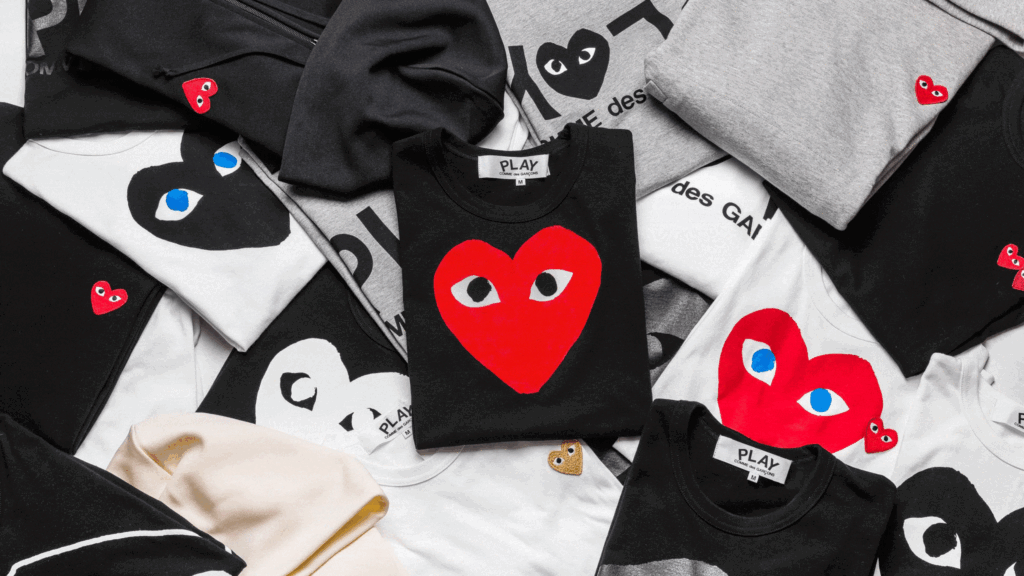
Perhaps the brand’s most recognizable line, Play introduced the red heart logo designed by Polish artist Filip Pagowski. The minimalist tees and sneakers offered a friendly gateway into the CDG universe.
2004 — Dover Street Market (London)
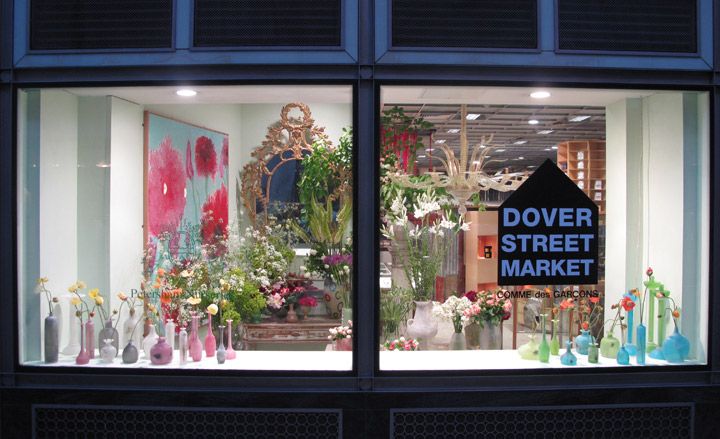
Kawakubo and her husband, Adrian Joffe, opened Dover Street Market (DSM), a revolutionary retail concept combining art installation and shopping experience. DSM has since expanded to Tokyo, New York, Los Angeles, Paris, and Beijing, redefining luxury retail.
2005–2009 — Collaborations and Experiments
Rei Kawakubo’s collaborations began shaping modern street culture:
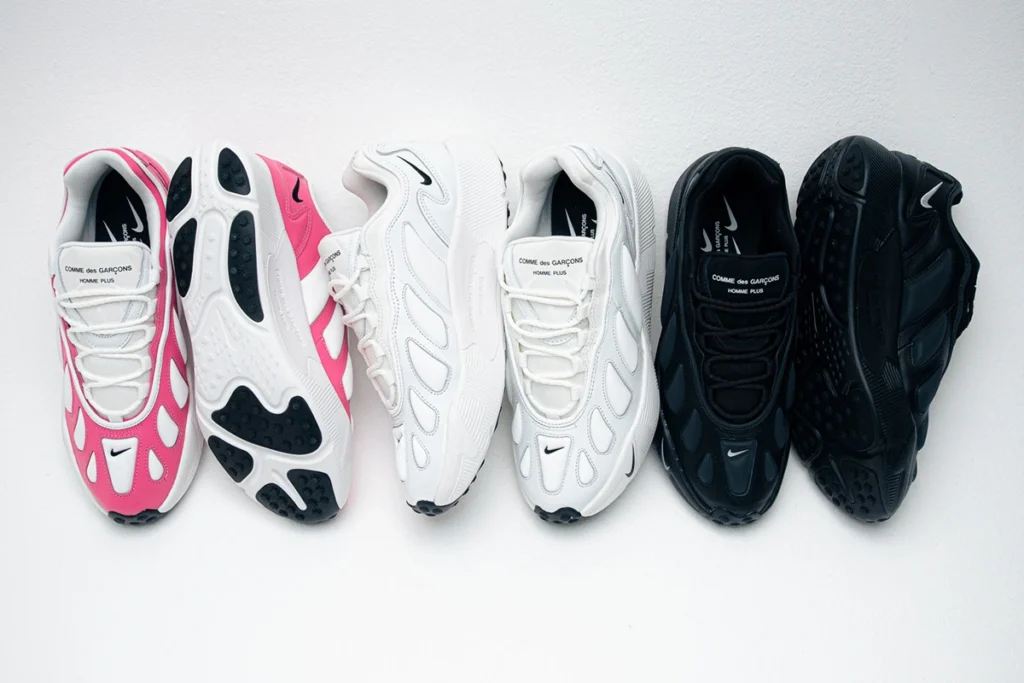
- Nike x CDG introduced avant-garde sneakers.
- Converse x CDG Play turned the Chuck Taylor into a global best-seller.
- H&M x Comme des Garçons (2008) made high fashion accessible to a new audience.
- Louis Vuitton x CDG combined heritage luxury with conceptual artistry.
These partnerships demonstrated Kawakubo’s ability to remain relevant while rejecting mainstream expectations.