⤷ The Tokyo Underground Scene
☗ INTRO: THE SOUND OF CLOTH TEARING IS THE SOUND OF REVOLUTION
Tokyo never sleeps — it hums.
Neon veins pulse through Shibuya, concrete breathes in Harajuku, and somewhere between chaos and stillness, Rei Kawakubo built an empire from imperfection.
❝ Fashion wasn’t supposed to be beautiful. It was supposed to be real. ❞
Comme des Garçons — “like the boys” — began not as a brand, but as a question.
What happens when clothes stop flattering and start challenging?
When fabric becomes philosophy?
When form forgets its rules?
In the Tokyo underground, where distortion is art and silence is rebellion, the answer has echoed for decades.
This is where Comme des Garçons was born.
This is where it still lives.
☉ CHAPTER I: TOKYO, CITY OF CONTRADICTIONS
“Beauty here hides in the cracks.”
Tokyo is not one thing.
It is many things — stacked, folded, rewired, layered like a Kawakubo pattern.
The city itself is a collage — vintage kimono next to chrome, shrine shadows beside vending machines glowing like cyber altars.
✶ Old gods meet new noise.
When Rei Kawakubo started Comme des Garçons in the early 1970s, she wasn’t thinking of Paris or fame. She was thinking of Japan — not the glossy postwar miracle, but the uncertain Tokyo that lived beneath it.
Students rioting. Artists hiding. The underground blooming like mold on the surface of perfection.
Her design language was born there:
– asymmetry instead of balance
– black instead of color
– holes instead of decoration
Each cut, each tear, each fold was Tokyo’s anxiety made tactile.
☗ CHAPTER II: THE BLACK WAVE
“In the 1980s, black became our flag.”
When Comme des Garçons hit Paris in 1981, critics didn’t know what to make of it.
The Western runway was full of opulence — sequins, silhouettes, and shine — and then came the black wave from Japan.
“Hiroshima chic,” they sneered.
But to Tokyo, it was liberation.
The holes weren’t mistakes.
The deconstruction wasn’t ruin — it was rebirth.
The absence of color wasn’t emptiness — it was protest.
Rei Kawakubo turned clothing inside out — literally and spiritually — echoing Tokyo’s postmodern heart.
It was an anti-fashion statement that resonated with youth tired of everything clean and perfect.
By then, underground Tokyo — from Koenji to Shimokitazawa — had already been experimenting with anti-style.
Vintage stores stacked with rejects, record shops selling noise tapes, punk zines photocopied in basements.
Comme des Garçons didn’t just fit in — it crowned the chaos.
✦ “It wasn’t fashion. It was freedom disguised as fabric.”
⌘ CHAPTER III: UNDERGROUND ECHOES
“Harajuku was never cute — it was coded.”
Long before “kawaii” became global shorthand for Japan’s street culture, Harajuku’s side streets were alive with experiments in identity.
Like secret languages stitched in cloth.
Comme des Garçons became a sacred symbol among those who didn’t belong anywhere else — artists, queer kids, skaters, poets, designers with no money but endless imagination.
You’d find them:
✧ in thrifted CDG jackets, patched with band logos
✧ in torn shirts reinterpreting Kawakubo’s asymmetry
✧ in dark cafes sketching future revolutions on napkins
⚡ “Harajuku wasn’t a style. It was survival.”
Every collection from Comme des Garçons was a new manifesto:
A refusal to be understood, a rejection of commercial clarity.
In that rejection, the underground found reflection.
Kawakubo’s world was not about beauty; it was about existence — the body as architecture, the garment as question, the runway as battlefield.
☽ CHAPTER IV: THE ANTI-FASHION MANIFESTO
❝ I work with strong concepts, but I am not interested in trends. ❞ — Rei Kawakubo
While global fashion sought applause, Kawakubo sought silence.
Her shows were conceptual storms — no music, no smiles, only movement and emotion.
She refused the conventions of femininity, masculinity, and Western glamour.
In Japan, this rejection resonated deeply — especially in Tokyo’s alternative scene, where labels were fluid and identity was collage.
✧ Fashion became thought. Thought became form.
Comme des Garçons embodied Tokyo’s ma — the Japanese concept of space, pause, emptiness that defines presence.
Clothes that breathe between stitches, like the quiet between two beats of techno in a Shibuya club.
⚙ CHAPTER V: TOKYO’S SOUNDTRACK
“Noise is our national anthem.”
The underground fashion of Tokyo doesn’t walk alone — it dances to the sound of experimental noise, industrial techno, avant-jazz.
The 1980s and ’90s saw a collision between music, art, and fashion.
In smoky venues like SuperDeluxe, Club Yellow, and Bat Cave, models, DJs, and painters mingled — all dressed in CDG.
The black drapes, the distorted forms, the defiance — it all mirrored the soundscapes of artists like Merzbow and Ryuichi Sakamoto’s experimental edge.
Tokyo’s youth were not imitating Paris; they were inventing Tokyo.
The underground scene became a mirror to Kawakubo’s revolution — one stitched in sound, light, and defiance.
☀ CHAPTER VI: THE ART OF NOTHINGNESS
“Less is not minimalism — it’s meaning.”
Western critics often misread Kawakubo’s aesthetic as minimalism.
But in Japan, her approach aligns more closely with Zen philosophy — the beauty of emptiness, imperfection, and impermanence.
⚫ “To create something new, you must first destroy.”
Her garments echo the wabi-sabi principle: beauty lies in decay, asymmetry, and incompleteness.
That idea resonates deeply with Tokyo’s underground — a city that reinvents itself every decade but never loses its ghosts.
In abandoned train tunnels turned art galleries, in graffiti-covered skate parks under expressways, the aesthetic of imperfection thrives.
Comme des Garçons isn’t just worn there — it’s lived there.
⚡ CHAPTER VII: THE OTHER SIDE OF COMME
“The brand that refused to be one.”
By the 1990s, Comme des Garçons had evolved into something far larger — yet it never forgot its origins.
The label multiplied:
— Comme des Garçons Homme Plus
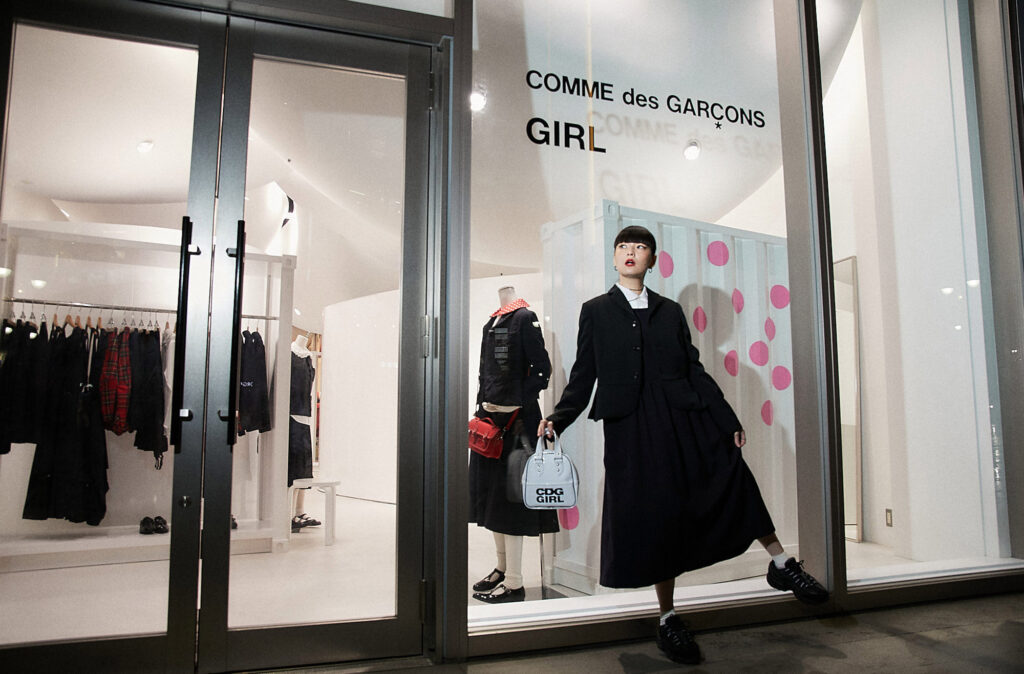
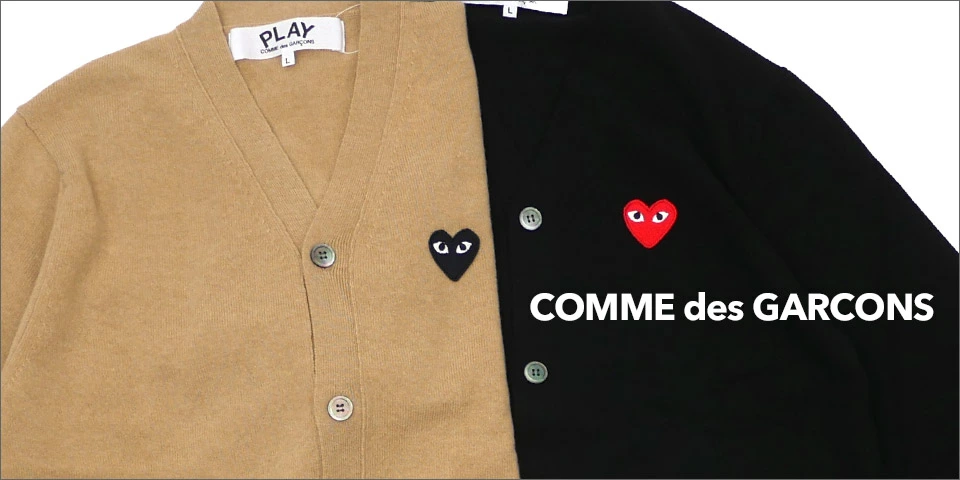
— Comme des Garçons Play
— Black Comme des Garçons
— Comme des Garçons Shirt
Each subline became its own dialect within the same radical language.
✶ “The brand speaks in fragments, but it tells one story: freedom.”
Even as CDG entered high fashion’s global circuit, Tokyo’s underground continued to embrace it not as luxury, but as legacy.
Wearing CDG wasn’t about wealth — it was about belonging to a lineage of resistance through design.
⚙ CHAPTER VIII: DOVER STREET, GINZA — THE TEMPLE OF CHAOS
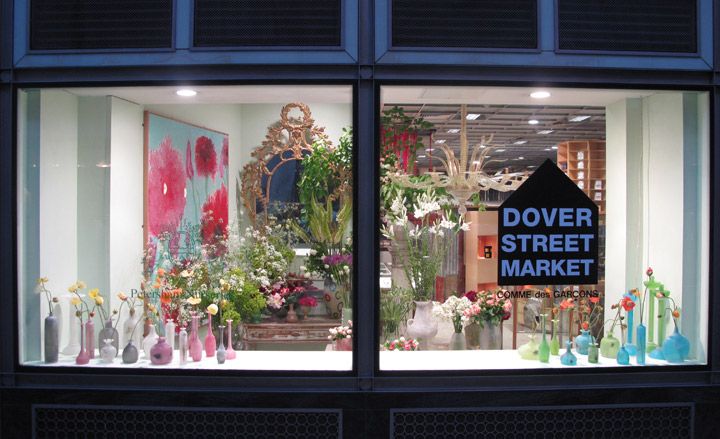
In 2012, Dover Street Market Ginza opened — a concept store designed by Kawakubo herself.
But to call it a store is a misunderstanding.
It’s a living installation.
Each floor feels like a different dimension — raw concrete next to golden mesh, mirrored corridors leading to handcrafted chaos.
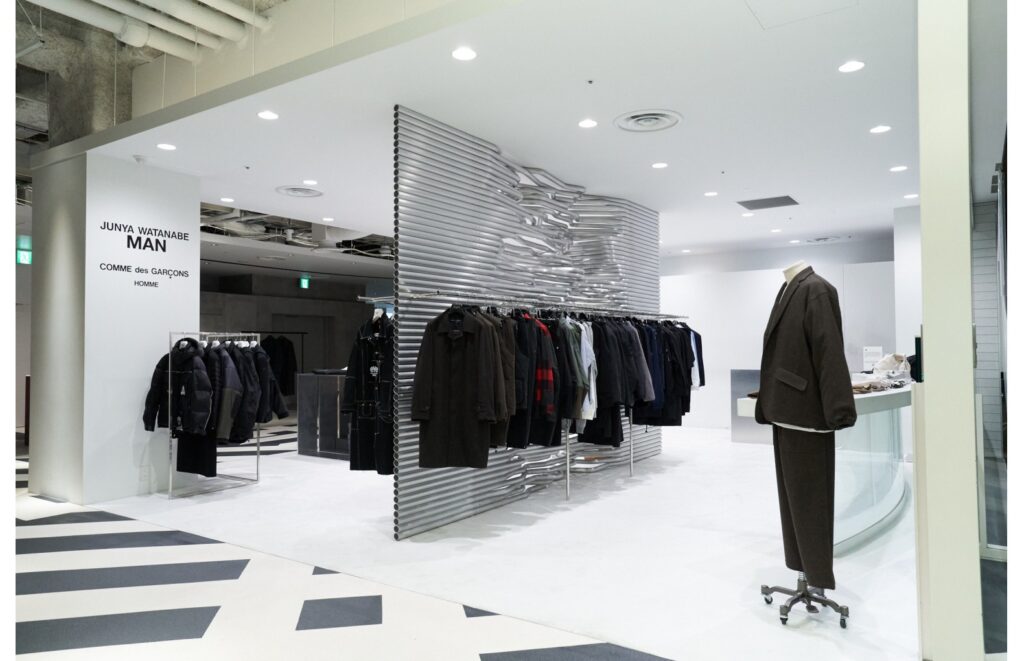
Brands coexist like independent tribes: CDG beside Undercover, Supreme beside Junya Watanabe, as if Tokyo’s underground spirit has been condensed into six stories of visual overload.
✦ “It’s not shopping. It’s pilgrimage.”
The store’s design mirrors Tokyo’s underground — restless, layered, unapologetically complex.
And every few months, it changes completely — like the city, like fashion, like identity itself.
☻ CHAPTER IX: KAWAKUBO’S LEGACY — THE INVISIBLE ARCHITECT
Rei Kawakubo rarely speaks.
When she does, her words are sharp, abstract, like brushstrokes of thought.
She once said:
“The only constant is that I am always trying to make something that didn’t exist before.”
That sentence defines not just her work but Tokyo’s entire creative pulse.
The underground here isn’t defined by aesthetics; it’s defined by attitude.
Kawakubo taught generations of Japanese designers that the true avant-garde isn’t about shock — it’s about truth.
Her disciples — Junya Watanabe, Tao Kurihara, Kei Ninomiya — all carry the torch forward, reshaping fashion in her fragmented, fearless image.
✹ CHAPTER X: THE YOUTH REBORN
“From thrift to theory — CDG’s next generation.”
In the 2020s, Tokyo’s underground has transformed again.
Young creatives born into the internet age reinterpret Comme des Garçons through streetwear, DIY culture, and digital expression.
Scroll through Instagram, and you’ll find underground stylists mixing CDG with vintage uniforms, thrifted military wear, even anime references — chaos made coherent.
At events like Fashion Freaks, Tokyo Art Book Fair, or EdgeOf Shibuya, you’ll see Kawakubo’s influence not as imitation but evolution.
The new underground wears Comme not as rebellion — but as ritual.
✧ “To destroy form is to find self.”
In these digital alleys, Comme des Garçons becomes a bridge — connecting old rebellion with new identity.
☯ CHAPTER XI: PHILOSOPHY OF THE VOID
“The beauty of not explaining.”
Rei Kawakubo never offers clear answers — and that’s the point.
Her silence invites interpretation; her designs provoke reflection.
This mirrors Tokyo itself — a city that thrives in ambiguity.
In Japan, meaning isn’t delivered — it’s discovered.
Comme des Garçons works the same way.
You don’t wear it to impress.
You wear it to express absence.
You wear it to ask questions without needing answers.
❝ To be misunderstood is to be truly original. ❞
This ethos became a kind of spiritual guide for Tokyo’s underground — an unspoken agreement that imperfection is art, and rebellion is ritual.
⚑ CHAPTER XII: THE GLOBAL UNDERGROUND — MADE IN JAPAN
The irony of Comme des Garçons is that its rebellion became global.
From New York to Berlin, from Seoul to London, creatives wear Kawakubo’s distortions as badges of belonging.
But even in the international spotlight, the essence remains Japanese.
Every piece carries Tokyo’s DNA — its noise, its silence, its contradictions.
⚫ “You can take Comme out of Japan, but you can’t take Japan out of Comme.”
In galleries, in clubs, in academic discussions — CDG is no longer just fashion.
It’s sociology, it’s philosophy, it’s poetry made wearable.
And still, beneath the glitter of the global stage, Tokyo’s underground keeps whispering its origin story — a reminder that this empire began in small, cracked rooms where creativity was survival.
☄ CHAPTER XIII: THE NEW EXPERIMENTALISM
Tokyo’s new wave of designers — Ava Nakano, Ryohei Kawanishi, Yuki Hashimoto, Tomo Koizumi — all reflect fragments of Kawakubo’s influence.
But they are not copies.
Street collectives like Kidill, Cote Mer, and Radd Lounge embody the next mutation of CDG’s aesthetic: recycled, genderless, radical, digital.
Their lookbooks feel like graffiti manifestos:
☾ glitch graphics
☾ found materials
☾ political noise
They prove that the Comme spirit is less about brand identity and more about creative honesty — the courage to make something ugly, beautiful, confusing, true.
☌ CHAPTER XIV: THE MYTH AND THE MACHINE
Even now, Comme des Garçons resists definition.
You can find its logo on perfume bottles, sneakers, and t-shirts with cartoon hearts.
But beneath the commerce, the underground soul still beats.
Every new collaboration — from Nike to Supreme — hides Kawakubo’s paradox:
How do you stay radical when you’re iconic?
The answer lies in her persistence to change — to destroy what works and begin again.
Each season, Comme des Garçons tears itself down to rebuild — just as Tokyo rebuilds after every quake, every era, every reinvention.
☾ CHAPTER XV: TOKYO AS TEXTILE
“The city itself wears Comme des Garçons.”
Stand on a Shibuya rooftop at midnight.
Look down.
The city moves like a garment — stitched by train lines, hemmed by highways, patterned in neon and shadow.
In a way, Tokyo is Comme des Garçons:
⚡ Fragmented.
⚡ Fearless.
⚡ Forever changing shape.
From the alleys of Koenji to the glass towers of Omotesando, the philosophy persists — creation through destruction, beauty through imperfection.
✸ CHAPTER XVI: THE UNDERGROUND STILL BREATHES
Though the global fashion world now reveres Rei Kawakubo as a legend, she remains a ghostly presence in Tokyo — rarely seen, always felt.
Her influence flows like static through the city’s veins.
At night, in a backroom gallery under Nakameguro Station, a small group of artists screen a short film made from stitched fabrics and noise recordings.
One of them wears a torn Comme des Garçons coat.
No logo. No explanation.
Only silence — and that’s enough.
✶ “Underground is not below — it’s within.”
Tokyo’s underground doesn’t die. It just changes disguise.
And as long as people keep creating outside the rules, Comme des Garçons will live there, forever at the edge of comprehension.
✹ EPILOGUE: THE BEAUTY OF DISORDER
The story of Comme des Garçons and the Tokyo Underground Scene is not linear — it’s a loop, a remix, a shadow of a sound.
It’s about what happens when fashion becomes philosophy, when chaos becomes clarity, when black becomes every color at once.
Tokyo is still writing this story — every day, every night, every corner where someone dares to create without permission.
⚡ Comme des Garçons is not a brand. It’s a mirror.
Look closely — and you’ll see the city staring back.